
Oil producers cartel OPEC's share in India's oil imports fell to an all-time low of 46 per cent in April as purchases of cheaper Russian oil peaked, industry data showed. Organization of the Petroleum Exporting Countries (OPEC) nations, mainly in the Middle East and Africa, had a 72 per cent share of all crude oil India imported in April 2022. This share slid to 46 per cent in April 2023, according to energy cargo tracker Vortexa.

India's unabated tryst with Russian crude oil is slowly coming to an end. The time has come for Indian refiners to navigate, creatively, the choppy waters of the post-honeymoon period, and for Indian policymakers to take cognisance of the broader impact on India from the spillover of the Russian crisis - after Washington's warning to transgressors last week. Shipments from Russia to India have averaged over 1.8 million barrels a day since February, according to data from Paris-based market analytics firm Kpler. But much of the crude shipped to India was non-sanctioned because it traded below a price cap set by the US led G-7 nations in December.
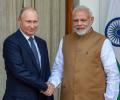
By driving a hard bargain with Russia in procuring crude oil at the lowest price possible, India is furthering the policy of G7 and Washington is "comfortable" with New Delhi over its approach in addressing issues relating to energy security, a top Biden administration official said.

Modi sees export-led growth one of the best ways to create jobs.

From 30 Sensex shares, Bajaj Finserv jumped nearly 8 per cent while Bajaj Finance soared over 6 per cent. Maruti, Titan, Mahindra, Mahindra & Mahindra, Infosys, HCL Tech, Zomato, UltraTech Cement and Kotak Mahindra Bank were the other major gainers. Sun Pharma emerged as the only laggard.

'As the global economy undergoes significant transformations in 2025, India's ability to navigate the complexities of trade wars, financial realignments, and emerging blocs will be pivotal,' explain Harsh V Pant and Soumya Bhowmik.

India's exports are unlikely to get an immediate boost from a depreciating rupee, which touched an all-time low on Monday, driven by rising commodity prices. The rupee fell to 76.97 against the dollar earlier in the day, settling 1.05 per cent weaker than the previous close. Oil prices soared to their highest since 2008 on Monday at $139 per barrel, after the US and European allies explored a Russian oil import ban, while delays in the potential return of Iranian crude oil to global markets increased supply fears.

'It won't be a V-shaped recovery. It'll be consolidation.' 'Investors might exit during that grind. It'll be painful.'

Moody's said it expects exposure to low oil prices to shave off 0.8 per cent from real GDP growth on average across oil exporting countries in 2016.

Contracting for the third month in a row, India's exports declined by 8.8 per cent to $33.88 billion in February due to slowdown in global demand, even as the trade deficit touched about a year low of $17.43 billion during the month, according to official data released on Wednesday. Imports also declined by 8.21 per cent to $51.31 billion as against $55.9 billion recorded in the corresponding month last year. Cumulatively, however during April-February this fiscal, the country's overall merchandise exports rose by 7.5 per cent to $405.94 billion.

Iran is India's largest importer of tea in value terms while in terms of volume, it is the second largest after Russia

There has been a dramatic decline in oil prices from the high of $147 a barrel in July, to less than a third of that today. However, it is too early to say if this is a fundamental change in the direction of oil prices, resulting from the announced cuts in production by the oil-exporting countries, or a blip in a falling market. The government seems to be assuming (or hoping that it is) the latter and is rushing ahead with its price cut plan.

India will soon meet Iraq and the United Arab Emirates (UAE) to seek a definitive rate of discount on crude oil similar to what Russia has provided so far, sources said. Multiple officials and industry executives said Iraq, which is India's biggest oil supplier, wants to discuss the level of discounts expected by Indian refiners. India's focus on snapping up ever-increasing volumes of Russian crude oil has led to a corresponding decline in imports from the Middle East. Flows from Iraq, Saudi Arabia, and the UAE have suffered as a result.

Siemens's share price has lost ground in the past few sessions following weak management commentary. The management indicated challenges to the growth outlook due to stagnant private capex and concerns over semiconductor shortages for digital industries. Government infra-spending may regain momentum from January 2025.

Oil-to-telecom conglomerate Reliance Industries Ltd (RIL) has surprised the street with a better than expected performance in its oil-to-chemicals (O2C) division in October-December 2024 (Q3FY25). RIL executives attributed it to favourable feedstock sourcing and higher volumes. However, they also listed cost optimisation and other measures.

'Trump administration wanted a positive tone at this summit, but there was still some anxiety that there could be some awkward moments -- and there were not.'

In a statement, the state government alleged 'malicious attempts' to discourage the use of products lacking a halal certificate not only seek 'unfair financial benefits' but also form part of a 'pre-planned strategy to sow class hatred, create divisions in society, and weaken the country' by "anti-national elements".
Exports grew to $16.34 billion while imports rose to $27.14 billion, leaving a trade deficit of $10.79 billion in July, according to official figures released in New Delhi on Monday. On the back of increase in global prices, the crude oil import bill in July shot up by 69.3 per cent to $9.48 billion from $5.6 billion a year ago.

As sanctions-hit Russia increasingly relies on consumer products from India, outbound shipments to Russia have started picking up for the second consecutive month in October. This comes after it witnessed contraction for six consecutive months starting March, commerce and industry ministry data showed. During October, India exported goods worth $280 million, up 3.7 per cent as compared to a year ago. It was led by demand for items such as vegetables, tea, coffee, chemicals as well as iron and steel products.

India's exports rose marginally by 1.62 per cent to $33.92 billion, while trade deficit more than doubled to $27.98 billion in August due to increased crude oil imports, commerce ministry data said on Wednesday. The revised data showed that imports rose by 37.28 per cent to $61.9 billion in August this year. The preliminary data released by the ministry on September 3 had shown a 1.15 per cent decline in exports to $33 billion in August.

The oil cartel's decision to maintain the production ceiling at its 2016 level, despite the recovery of the world economy, will ensure shortfalls in supply and high oil prices in the foreseeable future, warns Ambassador D P Srivastava.

Two-wheeler exports from India fell by 17.8 per cent to 3.65 million units in 2022-23 (FY23), according to data released by the Society of Indian Automobile Manufacturers (Siam) on Thursday. This decline is due to a rise in global inflation and the weakening of economies and currencies in key export markets of Africa, Latin America (LatAm), and South Asia. In contrast to FY23, two-wheeler exports from India jumped 35.4 per cent to 4.44 million units in 2021-22 (FY22).

Oil prices dipped on Wednesday as the market prepared for a gradual increase of Iranian exports into an already oversupplied market from 2016.
Exports in June rose by 23.52 per cent to $40.13 billion while the trade deficit ballooned to a record level of $26.18 billion mainly due to jump in gold and crude oil imports, the government data said on Thursday. The country's export growth in May was 20.55 per cent. Imports expanded by 57.55 per cent to $66.31 billion in June compared to the year-ago month, the data showed.

India's exports rose by 43 per cent to $35.65 billion in October while trade deficit widened to $19.73 billion during the month, according to the official data released on Monday. Imports soared by 62.51 per cent to $55.37 billion, widening the trade deficit. Export sectors which recorded positive growth during October include petroleum, coffee, engineering goods, cotton yarn/fabs./made-ups, gems and jewellery, chemicals plastic and linoleum and marine products, the data showed.

After Chennai, it is Coimbatore, Madurai, and Tiruchirappalli, that are emerging as manufacturing hubs. Coimbatore is India's top Tier-II city in terms of the number of GCCs, according to a report by Cushman & Wakefield.

'Netanyahu lured Trump into a trap by enticing him with a seductive scenario of massive lucrative business in Gaza's reconstruction.' 'Trump's imagination is running riot, completely disconnected from ground realities,' asserts Ambassador M K Bhadrakumar.

"We have the toughest sanctions ever imposed. But on oil, we want to go a little bit slow because I don't want to drive the oil prices in the world up," Trump told reporters.
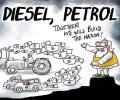
The Centre has garnered around Rs 2,500-3,000 crore in the first five weeks after it imposed a windfall tax on oil and gas companies for the export of fuel, Business Standard has learnt. It is likely that the government will continue with the one-time tax till the Indian crude basket is above $80 a barrel, sources said. The next review of the windfall tax on oil companies is early next week.

After a strong run in the midcap and smallcap indices, which surged 46 per cent and 43 per cent, respectively, on the National Stock Exchange (NSE) during Samvat 2080, analysts suggest that the rally in these segments may pause to catch its breath in Samvat 2081.

With Donald Trump all set to become US president, Indian exporters may face high customs duties for goods like automobiles, textiles and pharmaceuticals if the new US administration decides to pursue the 'America First' agenda, opined trade experts. Experts also said that Trump could also tighten H-1B visa rules, impacting costs and growth for Indian IT firms. Over 80 per cent of India's IT export earnings come from the US, making it vulnerable to changes in visa policies.
US President Donald Trump and Indian Prime Minister Narendra Modi met in Washington D.C. to discuss a range of issues including trade, defense, and energy. The two leaders announced plans to finalize "wonderful trade deals" for both countries, and Trump emphasized the need for India to purchase US oil and gas. Modi congratulated Trump on his second term and highlighted the importance of working together to further strengthen the India-US relationship. The meeting also addressed the ongoing conflict in Ukraine, with Modi reiterating India's commitment to peace.
India's exports rose by 2.14 per cent to $36.27 billion in July while the trade deficit almost tripled to $30 billion during the month due to over 70 per cent rise in crude oil imports, according to official data released on Friday. Imports shot up by 43.61 per cent to $66.27 billion in the month compared to July 2021, the data showed. The trade deficit was $10.63 billion in July 2021.
India's exports in January dipped by 6.58 per cent to $32.91 billion, as against $35.23 billion in the same month last year, according to the data released by the commerce ministry on Wednesday. Trade deficit in January stood at $17.75 billion.

Tea planters and exporters are "extremely worried" over the possible impact on their shipments to Russia, India's second largest buyer of tea, in the wake of the Russia-Ukraine crisis. Western sanctions and disruption of payments in dollars as well as transhipments to Russia are expected as a fall-out of Russia launching an attack on Ukraine on Thursday. "The Russian market for Indian tea is extremely important as there are payment issues for shipments to Iran, another vital tea export destination. "Around 18 per cent of India's tea shipments go to Russia," India Tea Association chairperson Nayantara Palchoudhuri told PTI.

From the 30-share blue-chip pack, Zomato surged over 7 per cent. Maruti, ITC Hotels, ITC, Mahindra & Mahindra, Asian Paints, Titan and IndusInd Bank were among the biggest gainers. Power Grid, Larsen & Toubro, NTPC, UltraTech Cement, HCL Tech, Tech Mahindra, Infosys and Adani Ports were among the laggards.

The surprise decision of OPEC and its allies, including Russia, to cut oil output may cause an immediate rise in prices, delaying revision in fuel prices in India, industry sources said. The grouping of Organisation of Petroleum Exporting Countries (OPEC) and its allies, called OPEC+, on Sunday decided to further cut oil output by around 1.16 million barrels. The move led to Brent rising by almost 6 per cent to $84.58 per barrel on Monday.
Russia dominated Saudi Arabia in oil supplies as the world's fastest-growing major economy for fossil fuels in October, relegating the Kingdom to third place. Iraq was India's top oil supplier, according to the data from Vortexa. Saudi Arabia's decline in India's oil market has coincided with Russia's rise, and ironically occurred amid growing diplomatic ties between Riyadh and New Delhi. Saudi Crown Prince Mohammed bin Salman Al Saud is visiting India this month to meet Prime Minister Narendra Modi.

India's merchandise exports in June rose by 16.78 per cent year-on-year to $37.94 billion while the trade deficit ballooned to a record $25.63 billion on account of a steep increase in gold and crude oil imports, according to the government's preliminary data released on Monday. The export growth in June moderated from 20.55 per cent in May and 48.34 per cent in June 2021. During the month under review, exports of engineering, pharmaceutical and plastic products recorded negative growth.

The impact of Trump's announcement of increasing import tariffs will have negligible benefit for India not because of companies trying to shift from China to other countries or their supply chains being affected due to their Chinese operations but because of our faulty policies, explains Mudit Jain.
